[The Times, Journalist Tae-sik Ma]
With approximately four months remaining until the opening, the Organizing Committee for the 2026 Daegu World Masters Athletics Championships has unveiled its preparation status, expressing strong confidence in successfully hosting the event.
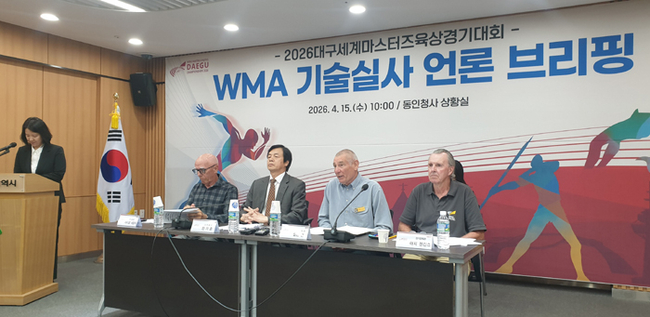
At a press conference held on April 15 at the Situation Room on the second floor of
Daegu City Hall, an inspection delegation from World Masters Athletics (WMA) shared the results of its on-site review after visiting Daegu for several days.
The championships will take place from August 22 to September 3, centered around Daegu Stadium. Approximately 12,000 participants from about 90 countries are expected, making it the largest Masters athletics event in history. Open to anyone aged 35 and older, the event emphasizes not only competition but also health, exchange, and celebration.

“Facilities and Operations Meet International Standards”
Ki-Hoon CHIN, Secretary-General of the Organizing Committee, stated during the briefing,
“Daegu is building on its successful hosting experience of the 2011 World Championships in Athletics and the 2017 World Masters Indoor Championships.”
A total of 34 events will be held across key venues including Daegu Stadium, Suseong Family Park, and Gyeongsan Civic Stadium. All facilities meet international standards.
Notably, the tracks at both the main and auxiliary stadiums have been replaced with
world-class German-made surfaces and have received international certification.
The road race courses have also been officially certified.
In terms of operations, 400 referees from the Korea Association of Athletics Federations, 200 operational staff members, and 45 international volunteer officials will be deployed. A high-performance electronic timing system will ensure precise measurement of
results. In addition, a mobile application will provide real-time schedules and results,
and major events will be live-streamed online.
.Comprehensive Preparations for Transportation, Accommodation, and Tourism
The Organizing Committee is also making systematic preparations to enhance participant convenience in transportation, lodging, and tourism.
Eight shuttle bus routes will connect Daegu Airport, Dongdaegu Station, and major accommodations, while foreign participants will be provided with free transportation cards. Approximately 8,000 hotel rooms within a 20 km radius of Daegu Stadium have been secured.
Furthermore, cultural performances, experiential programs, market streets,
and food zones will be operated, expanding the event beyond a sports competition
into a “stay-type international tourism festival.”
WMA Inspection Team: “Daegu Shows a Very High Level of Readiness”
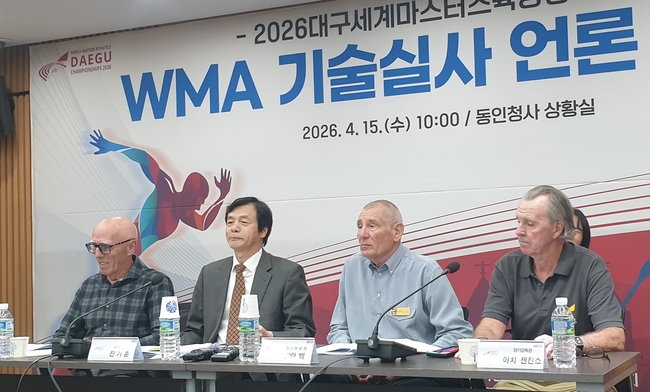
The WMA inspection team gave high marks to Daegu’s preparations.
Alan Bell, Vice President of WMA, stated, “Daegu will become the first city in the world to host both indoor and outdoor Masters championships.
The level of facility investment and organizational preparation is highly impressive, and we are confident this will be a successful event.”
He added that the event will generate significant economic impact, noting that participants, their families, and companions will contribute to local consumption.
Michael Seralta, Competition Director, commented,
“After inspecting all venues, we found the preparation status to be excellent, and athletes will be highly satisfied with the facilities.”
Archie Jenkins, another official, highlighted the urban course and the Suseong Lake area, describing them as “attractive spaces where athletes and their families can enjoy
time even after competitions.”

“Participation Goals Achievable” Despite Global Uncertainty
In response to concerns that global instability, such as tensions in the Middle East, could affect participation, the Organizing Committee outlined its strategy.
Secretary-General CHIN stated,
“Although variables such as rising airfares exist, we are focusing on attracting participants from Asia, including Japan, China, and Hong Kong. Considering the tendency for registrations to surge near the deadline, we believe our target is achievable.”
Incentive programs for foreign residents in Korea are also under review.

“Safety Is Not an Option, but a Basic Principle” — Strengthening Heatwave Response
Given the summer schedule, heatwave response has been identified as a key priority.
The committee plans to expand water stations, operate cooling zones, and reinforce
medical personnel and equipment. For long-distance events such as the half marathon, water stations will be installed every 1 km, and medical support will be provided every 2 km.
Secretary-General CHIN emphasized,
“We have established manuals to respond to extreme weather conditions such as heatwaves and typhoons, and built an emergency response system in cooperation with
police, fire departments, and medical institutions. We will ensure the event is conducted safely under any circumstances.”

Estimated Economic Impact: KRW 146 Billion
According to an analysis by the Daegu Policy Institute, the event is expected to generate KRW 146 billion in production inducement effects, KRW 57.9 billion in added value, and approximately 1,573 jobs.
The Organizing Committee anticipates that the event will not only stimulate the local
economy but also enhance Daegu’s global city image.
The committee concluded,
“We aim to create a global sports festival where athletics enthusiasts from around the world and Daegu citizens come together. We will dedicate all remaining efforts to
ensure success.”